Showing posts with label books. Show all posts

Thursday, November 13, 2008

Ideological Critique

Adventures of Huckleberry Finn uses the word "nigger" over 200 times. The Merchant of Venice depicts the humiliation and ruin of a Jewish villain at the hands of a Christian majority; Othello, a negro who strangles his perfectly innocent wife. The famous first line of Pride and Prejudice can be read as a blatant formula for prostitution, if one so chooses. The women of Sir Gawain and the Green Knight inspire and manipulate their men, but don't engage in any decapitating contests themselves.

It's relatively easy to point one's finger at a work of art, especially challenging art, and denounce it as ideologically unsavory in some way. Anyone can (re)apply this or that political formula (e.g. the "Woman in the Refrigerator," or any of the dozens of other ways to reduce a story to who's-doing-what-to-whom) and bandy about the -isms of the day in a denunciatory fashion. There are people with tenure right now who have made entire careers out of little else. It's a lot harder, however, to make a sincere effort to participate in an artist's world view, to try to give him or her the benefit of the doubt, to make an honest and uncompromising critique that nonetheless adds value to the world rather than merely taking it away.

I'm talking about imaginative generosity, not apologia. And I'm not always great at taking my own advice--I talk more lazy, cheap, snide, cynical shit than a lot of people I know. I'm just saying I'd rather watch Othello than Gothika.

(Image from mincer.en.alibaba.com.)

Thursday, November 6, 2008

Yahoos on Yahoo

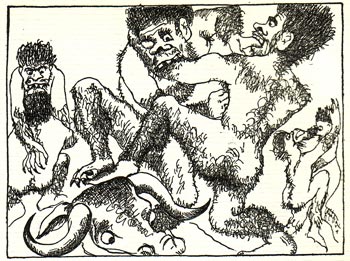
So I was reading this news story about a fat man who killed his wife on Yahoo news today, and I impulsively clicked on the "comments" section. What I found there was worthy of part 4 of Gulliver's Travels:

"Throw the fat prick in jail!"

"omg!"

"These people are a threat and menace to our society!"

"U FAT FK" (my favorite)

I was so inspired by this sparkling commentary that I decided to leave one of my own:
When I want quality conversation, I go to the comments section of Yahoo news. Where else could I find so many people willing to share their informed, measured and enlightening opinions? Keep up the great work, folks!

When I tried to post it, however, I got the following message: "Oops! The comment you entered contained abusive language. Please re-enter and try again."

I can't tell if Yahoo's abuse filter is stupid or really smart.

(Image from www.lqart.org.)

Monday, November 3, 2008

Hipsters Hatin' on Hipsters

I just finished reading Adbusters' July 2008 article, "Hipster: The Dead End of Western Civilization", and I think Douglas Haddow got it mostly wrong--the counterculture hasn't lost its values at all. The beatniks, the hippies, the punks, the hip-hoppers, the ravers, the anti-consumer movement, etc. all concern(ed) themselves with an elaborate system of in-group fashion semiotics and justifications for having a good time (i.e. looking good and having fun) couched in contemporary political terms. Today's kids may just want to party without feeling as obliged to justify it as "subversive" or "revolutionary," but if they still want to be different from (i.e. cooler than) the kids across the street, then the aforementioned "countercultural" values are intact, minus some of the political pretension. I say good for them. Posers will always be posers, but posers who think they're activists are worse.

I can sympathize with Mr. Haddow's disappointment that the hipsters of 2008 aren't into the same militant anti-consumer pseudo-activism that the hipsters of 2000 were. Before too long, there might not be anyone left to buy Adbusters.

(Image from kidsnpets.files.wordpress.com. Read Joseph Heath and Andrew Potter's book for a better discussion of this subject.)

Tuesday, April 22, 2008

Milton's Satan


...Thus far these beyond
Compare of mortal prowess, yet observed
Their dread commander: he above the rest
In shape and gesture stood proudly eminent
Stood like a Tow'r; His form had not yet lost
All her Original brightness, nor appear'd
Less than archangel ruined and th'excess
Of Glory obscur'd: As when the Sun new ris'n
Looks through the Horizontal misty Air
Shorn of his Beams, or from behind the Moon
In dim Eclipse disastrous twilight sheds
On half the Nations, and with fear of change
Perplexes Monarchs. Darken'd so, yet shone
Above them all th'Arch Angel: but his face
Deep scars of Thunder had entrenched, and care
Sat on his faded cheek, but under Brows
Of dauntless courage, and considerate Pride
Waiting revenge: cruel his eye, but cast
Signs of remorse and passion to behold
The fellows of his crime, the followers rather
(Far other once beheld in bliss) condemn'd
For ever now to have their lot in pain,
Millions of Spirits for his fault amerc't
Of Heav'n, and from Eternal Splendors flung
For his revolt, yet faithful how they stood,
Their Glory wither'd. As when Heaven's Fire
Hath scath'd the Forest Oaks, or Mountain Pines,
With singed top their stately growth though bare
Stands on the blasted Heath. He now prepar'd
To speak; whereat their doubl'd ranks they bend
From Wing to Wing, and half enclose him round
With all his Peers: attention held them mute.
Thrice he assay'd, and thrice in spite of scorn,
Tears such as Angels weep, burst forth: at last
Words interwove with sighs found out their way.

"O Myriads of immortal Spirits, O Powers
Matchless, but with th'Almighty, and that strife
Was not inglorious, though th'event was dire,
As this place testifies, and this dire change
Hateful to utter, but what power of mind
Forseeing or presaging, from the Depth
Of knowledge past or present, could have fear'd,
How such united forces of Gods, how such
As stood like these, could ever know repulse?
For who can yet believe, though after loss,
That all these puissant legions, whose exile
Hath emptied Heav'n, shall fail to re-ascend
Self-rais'd, and repossess their native seat.
For me, be witness all the Host of Heav'n,
If counsels different, or danger shunn'd
By me, have lost our hopes, but he who reigns
Monarch in Heav'n, till then as one secure
Sat on his throne, upheld by old repute,
Consent or custom, and his Regal State
Put forth at full, but still his strength conceal'd,
Which tempted our attempt, and wrought our fall.
Hence forth his might we know, and know our own
So as not either to provoke, or dread
New war, provok't, our better part remains
To work in close design, by fraud or guile
What force elected not: that he no less
At length from us may find, who overcomes
By force hath overcome but half his foe.
Space may produce new Worlds; whereof so rife
There went a fame in Heav'n that he ere long
Intended to create, and therein plant
A generation, whom his choice regard
Should favor equal to the Sons of Heav'n:
Thither, if but to pry, should be perhaps
Our first eruption, thither or elsewhere:
For this Infernal Pit shall never hold
Celestial Spirits in Bondage, nor th'Abyss
Long under darkness cover. But these thoughts
Full counsel must mature: Peace is despair'd,
For who can think Submission? War then, War
Open or understood must be resolv'd."

He spake: and to confirm his words, out-flew
Millions of flaming swords, drawn from the thighs
Of mighty Cherubim: the sudden blaze
Far round illumin'd hell: High they rag'd
Against the Highest, and fierce with grasp'd arms
Clash'd on their sounding shields the din of war,
Hurling defiance toward the vault of Heav'n.

(Paradise Lost 1:587-669. Image of Gustave Doré's woodcut from www.all-art.org)

Wednesday, March 19, 2008

Goodbye, Arthur C. Clark (1917-2008)

Arthur C. Clark had a very good run. In addition to being an excellent science fiction writer, he was also an accomplished scientist. Childhood's End is probably my favorite of his books, although I also liked Songs of Distant Earth for more sentimental reasons.

(Image from latimes.com)

Wednesday, February 20, 2008

On Natural Selection: Letter to The Argosy

Dear Argosy:

This letter concerns G.H.'s review of On Natural Selection by Charles Darwin in the February 14 2008 issue of The Argosy. I will start by applauding Mr. H.’s choice of book for review. Charles Darwin is often overlooked and misunderstood by otherwise educated and perceptive readers, and it made my heart glad to see his face in The Argosy. However, as I see it, the review itself had 3 major problems:

1. Mr. H.’s description of ONS as “a scientific publication meant for an audience of science nerds, not literature geeks” is a glib mischaracterization of both the literate public and Darwin’s work. The Origin of Species, from which ONS is taken, is widely regarded as a literary landmark as well as a scientific one. It requires no specialized scientific knowledge in order to understand it, and may serve as a paragon of thematic focus and argumentative integrity for any serious humanities student. Darwin was not writing for “nerds,” but for the whole human race, and the theory of natural selection—his gift to posterity—is one of the most profoundly original, true and beautiful ideas in the living world.

2. An “elegant” prose style is characterized not by aesthetic gush, but by graceful refinement, clarity, economy, and dignity: this is precisely the kind of writing found in Charles Darwin’s fine book. While there is nothing wrong with Mr. H.’s admission that he found the book difficult, he crosses a line by suggesting that Darwin, rather than Mr. H. himself, is at fault for this. It is boorish and incredibly arrogant for a student reviewer to hold a classic work of literature, even an abridged one like On Natural Selection, to his own self-indulgent standard of “readability.” He should instead consider measuring his own skill as a reader against the challenge such a work offers.

3. If Mr. H. understood Darwin’s ideas, he would be less eager to place them in proximity to so-called “social Darwinism.” Far from being a mere “extrapolation” of the theory of natural selection into the human realm, social Darwinism is fundamentally a misunderstanding, not a misapplication, of Darwinian evolution. Even the most basic understanding of human biology is actually incompatible with pseudoscientific racism. The all-too-human urge to evaluate something negatively before we fully understand it, however, has been responsible for, or at least complicit in, many of the bloodiest crimes in human history.

Mr. H. and self-styled “literature geeks” interested in the humanistic implications of Darwinian ideas may find the following works of use:

Carroll, Joseph. Literary Darwinism: Evolution, Human Nature, and Literature. New York: Routledge, 2004.

Pinker, Steven. The Blank Slate: The Modern Denial of Human Nature. New York: Penguin, 2002.

Storey, Robert. Mimesis and the Human Animal: On the Biogenetic Foundations of Literary Representation. Evanston, IL: Northwestern University Press.

Tooby, J. and Cosmides, L. “The Psychological Foundations of Culture.” In J.H. Barkow, Tooby J. and Cosmides L. (eds.). The Adapted Mind: Evolutionary Psychology and the Generation of Culture (pp. 19-136). New York, Oxford University Press.

Turner, Frederick. The Culture of Hope: A New Birth of the Classical Spirit. New York: Free Press, 1995.

Wilson, Edward O. Consilience: The Unity of Knowledge. New York: Vintage Books, 1998.

Regards,

John

(image from www.northernsun.com)

Monday, February 18, 2008

Naked Baby with Book


Two things you can say about my family: we love to get naked and we love to read. In this instance, Jack climbed up into the orange easy chair, peed on it, and then sat down in the puddle to read Robert Munsch's wonderful Love You Forever (we don't normally let our son wallow in his own urine, but somehow it just happened). This picture now resides in a special file titled Pics to Show the Prom Date.

Saturday, February 2, 2008

The Metaphysical Cast of Mind

Joseph Carroll writes in his book Literary Darwinism that the "metaphysical cast of mind" is characterized by a "naive humanistic faith in the supreme efficacy of grandiose abstractions" and a "credulous susceptibility to 'Big Words.'" He contrasts this with the scientific approach (exemplified, according to Carroll, in Robert Storey's book Mimesis and the Human Animal), which places its faith instead in a "cumulative and self-correcting body of empirical information" (Carroll 59).

I love the turn of phrase (said the rambling humanist) and I think he has a point. Sobriety of style is something all serious writers should strive for. On the other hand, if philosophy and literary criticism could be fully assimilated into said "cumulative and self-correcting body of empirical information," we'd probably call them physics, biology and information theory.

I will continue to put my own (possibly naive) humanistic faith in the curious gods of our universe, science among them.

(Image from www.bilkent.edu.tr)

Thursday, December 20, 2007

The Fat Celt Wept

We're studying Japan and Korea in my grade 7 social studies class and this week, among other things, we've been talking about the atomic bomb. Yesterday I thought it would be a good idea to read Eleanor Coerr's Sadako and the Thousand Paper Cranes aloud to my students. Since I was in 4th grade the last time I read that book, I had forgotten just how sad it is. It's probably the saddest kids' book I've ever come across, after Charlotte Graeber's Mustard. So anyway, I got to the end, where it reads

The next time she awoke, the family was there. Sadako smiled at them. She was part of that warm, loving circle where she would always be. Nothing could ever change that.

Already lights were dancing behind her eyes. Sadako slid a thin, trembling hand over to touch the golden crane. Life was slipping away from her, but the crane made Sadako feel stronger inside.

She looked at her flock hanging from the ceiling. As she watched, a light autumn breeze made the birds rustle and sway. They seemed to be alive and flying out through the open window. How beautiful and free they were! Sadako sighed and closed her eyes.

She never woke up (Coerr 63).

and of course I had tears streaming down my face like a goddamn girl. Gah! I'm 6' tall, 240 lbs with a shaved head and a chinstrap beard and I'm crying like a baby in front of a bunch of preteens. All I could think to say was, "Sorry, guys, It's a sad book." It's part of my nature to be a sentimental mangina on the best of days, but I'm good at covering it up with my relatively scary appearance, deep voice and witty faux cynicism.

But not yesterday.

I'm not a "new age" guy. I'm not "emo." In fact, my wife can probably testify as to how insensitive I am. But I'm easily moved to tears by literature. That part in Chaucer's "The Knight's Tale" when a dying Aricte cries, "Mercy, Emilie!" gets me every time. Never before, however, have I gotten all weepy in front of a class full of kids.

I guess the point of this story is twofold: a) I'm a big, bald pussy; and b) If you're going to read Sadako and the Thousand Paper Cranes to a grade 7 class, practice in private and make sure you can get through it first.

Jezis Maria.

Friday, December 14, 2007

The Golden Compass: Atheist Propaganda?

I just read The Golden Compass: Agenda Unmasked, a 23 page tract by the Catholic League for Religious and Civil Rights about how Phillip Pullman wants to turn my kids into atheists. I get the impression that this is the kind of controversy he's been looking for all along, but the stupid things people are saying about his books still get under my skin.

According to the Catholic League, the point of The Golden Compass movie is to slip a camouflaged, diluted form of atheism in under parents' radar to get kids hooked. These brainwashed youngsters will then ask for the trilogy of novels for Christmas, and their atheist indoctrination will be well underway. I haven't seen the TGC movie yet, and I've heard Hollywood has watered it down and omitted some of the more explicit connections between the Magisterium and the Catholic church in order to give it a broader appeal. If this is true, it's unfortunate, but the filmmakers obviously did this to placate Christians (who probably comprise the majority of the film's U.S. target market), not hoodwink them.

I wonder what the halfwits who are up in arms about The Golden Compass would make of the works of William Blake or John Milton. If they can't even get through 3 children's books, relying instead on secondary sources like the "synopsis" in the aforementioned pamphlet, it's probably safe to assume that it won't ever become an issue.

Rupert Kaye, chief executive of the Association of Christian Teachers, claims it is "revealing... that Pullman chose not to add Allah to his list of names" (for God, depicted as a mendacious angel called the Authority in the books). Now that's food for thought: the atheists in league with Islam. Mr. Kaye has obviously considered this scenario carefully.

Says Caroline Moore, comparing TGC to Narnia in The Spectator: "Lewis's version is informed by his Christianity; Pullman's driven, far more explicitly, by militant atheism." Apparently Christians are informed but atheists are driven, just like the animals they believe we're descended from. When Richard Dawkins compared atheist and homosexual politics in The God Delusion (a book I found snide and disrespectful of religion and which, incidentally, sings Pullman's praises), I thought he was being melodramatic. Now, I'm not so sure.

I support Philip Pullman unequivocally and I will continue to encourage my students to read his books. Censorship, ignorance and hysteria are enemies of truth and beauty, of civilization and of God.

Sunday, November 18, 2007

I Just Finished Books of Blood 4-6 (Sickest Post Ever)

I just finished reading the Books of Blood 4-6 omnibus by Clive Barker. The final story in Book 6, entitled "The Last Illusion", contains what might just be the most twisted passage I have ever read in any book:

Though he tried to form the simple word, "No", the music was gaining influence upon him with every note played. He began to hear melodies in the caterwauling; long, circuitous themes that made his blood sluggish and his thoughts idiot. He knew there was no pleasure to be had at the music's source--that it tempted him only to pain and desolation--yet he could not shake its delirium off. His feet began to move to the call of the pipers. He forgot Valentin, Swann and all ambition for escape, and instead began to descend the stairs. The melody became more intricate. He could hear voices now, singing some charmless accompaniment in a language he didn't comprehend. From somewhere above, he heard his name called, but he ignored the summons. The music clutched him close, and now--as he descended the next flight of stairs--the musicians came into view.

They were brighter than he had anticipated, and more various. More baroque in their configurations (the manes, the multiple heads); more particular in their decoration (the suit of flayed faces; the rouged anus); and, his drugged eyes now stung to see, more atrocious in their choice of instruments. Such instruments! Byron was there, his bones sucked clean and drilled with stops; his bladder and lungs teased through the slashes in his body as reservoirs for the piper's breath. He was draped, inverted, across the musician's lap, and even now was played upon--the sacs ballooning, the tongueless head giving out a wheezing note. Dorothea was slumped beside him, no less transformed, the strings of her gut made taut between her splinted legs like an obscene lyre, her breasts drummed upon. There were other instruments too, men who had come off the street and fallen prey to the band. Even Chaplin was there, much of his flesh burned away, his rib-cage played upon indifferently well
(Barker 142-3).

Clive Barker is a talented writer, but I wonder how he sleeps at night.

(Image enlarged from "The Garden of Earthly Delights" by Hieronymus Bosch courtesy of Wikimedia)

Thursday, October 25, 2007


"My only grudge against nature was that I could not turn my Lolita inside out and apply voracious lips to her young matrix, her unknown heart, her nacreous liver, the sea-grapes of her lungs, her comely twin kidneys" (Nabukov 165).

"It is not the artistic aptitudes that are secondary sexual characters as some shams and shamans have said; it is the other way around: sex is but the ancilla of art" (259).

"The moral sense in mortals is the duty
We have to pay on mortal sense of beauty" (283).