Showing posts with label Religion. Show all posts

Tuesday, November 10, 2009

False Start


Hell’s not just pain, it’s triviality—
A play that no one else would come to see.
Null dimension; crushing gravity.

“We suffer when we can’t let go,” they say,
“The self’s all just attachments anyway.
Unclench your heart and learn to love today.”

“Just bondage” seems reciprocal to me.
I’ll pay my creditors before I’m free—
To “let it go” would mean my bankruptcy.

Still others preach, “For us it has sufficed
To think about what Jesus sacrificed.
Repent your sins and give your life to Christ.”

If praising God with practices devout
Can free the soul from pain, regret, and doubt,
Why does it feel so much like “selling out?”

A colder voice sneers, “Fuck it, let’s be blunt:
Life is death. You don’t get what you want.
God’s a fiction; Gaia is a cunt.

“You won’t give up your dead biologist—
Her mangled hands, those dry, cracked lips you kissed.
You cursed God then—admit it, don’t resist.”

It’s true, and I’m addicted to that pain—
The wormy muse’s singular refrain,
The eggs it lays inside my beating brain.

I’ll rest awhile and then I’ll try again—
It’s hard work setting fire to these straw men.


[Image from walletmouth.typepad.com.]

Friday, October 10, 2008

The Meaning of Life

Kilgore Trout once wrote a short story which was a dialogue between two pieces of yeast. They were discussing the possible purposes of life as they ate sugar and suffocated in their own excrement. Because of their limited intelligence, they never came close to guessing that they were making champagne.

--Kurt Vonnegut, Breakfast of Champions pp. 208-9.

(Image from "universe-review.ca.)

Friday, May 2, 2008

Caitlin and Chloe Talk Gnostic


I overheard this hilarious bit of conversation between my daughters Caitlin (8) and Chloe (6) as they sat on the floor drawing this afternoon. It came right out of the blue:

CAITLIN: Mother Nature is God's wife.

CHLOE: If we have God in our hearts, then he had a ton of babies. In God's world, boys get pregnant.

CAITLIN: They'd be like, "Is it Mother Nature Junior, or God Junior?"

(Image from www.membres.lycos.fr)

Friday, December 14, 2007

The Golden Compass: Atheist Propaganda?

I just read The Golden Compass: Agenda Unmasked, a 23 page tract by the Catholic League for Religious and Civil Rights about how Phillip Pullman wants to turn my kids into atheists. I get the impression that this is the kind of controversy he's been looking for all along, but the stupid things people are saying about his books still get under my skin.

According to the Catholic League, the point of The Golden Compass movie is to slip a camouflaged, diluted form of atheism in under parents' radar to get kids hooked. These brainwashed youngsters will then ask for the trilogy of novels for Christmas, and their atheist indoctrination will be well underway. I haven't seen the TGC movie yet, and I've heard Hollywood has watered it down and omitted some of the more explicit connections between the Magisterium and the Catholic church in order to give it a broader appeal. If this is true, it's unfortunate, but the filmmakers obviously did this to placate Christians (who probably comprise the majority of the film's U.S. target market), not hoodwink them.

I wonder what the halfwits who are up in arms about The Golden Compass would make of the works of William Blake or John Milton. If they can't even get through 3 children's books, relying instead on secondary sources like the "synopsis" in the aforementioned pamphlet, it's probably safe to assume that it won't ever become an issue.

Rupert Kaye, chief executive of the Association of Christian Teachers, claims it is "revealing... that Pullman chose not to add Allah to his list of names" (for God, depicted as a mendacious angel called the Authority in the books). Now that's food for thought: the atheists in league with Islam. Mr. Kaye has obviously considered this scenario carefully.

Says Caroline Moore, comparing TGC to Narnia in The Spectator: "Lewis's version is informed by his Christianity; Pullman's driven, far more explicitly, by militant atheism." Apparently Christians are informed but atheists are driven, just like the animals they believe we're descended from. When Richard Dawkins compared atheist and homosexual politics in The God Delusion (a book I found snide and disrespectful of religion and which, incidentally, sings Pullman's praises), I thought he was being melodramatic. Now, I'm not so sure.

I support Philip Pullman unequivocally and I will continue to encourage my students to read his books. Censorship, ignorance and hysteria are enemies of truth and beauty, of civilization and of God.

Monday, December 3, 2007

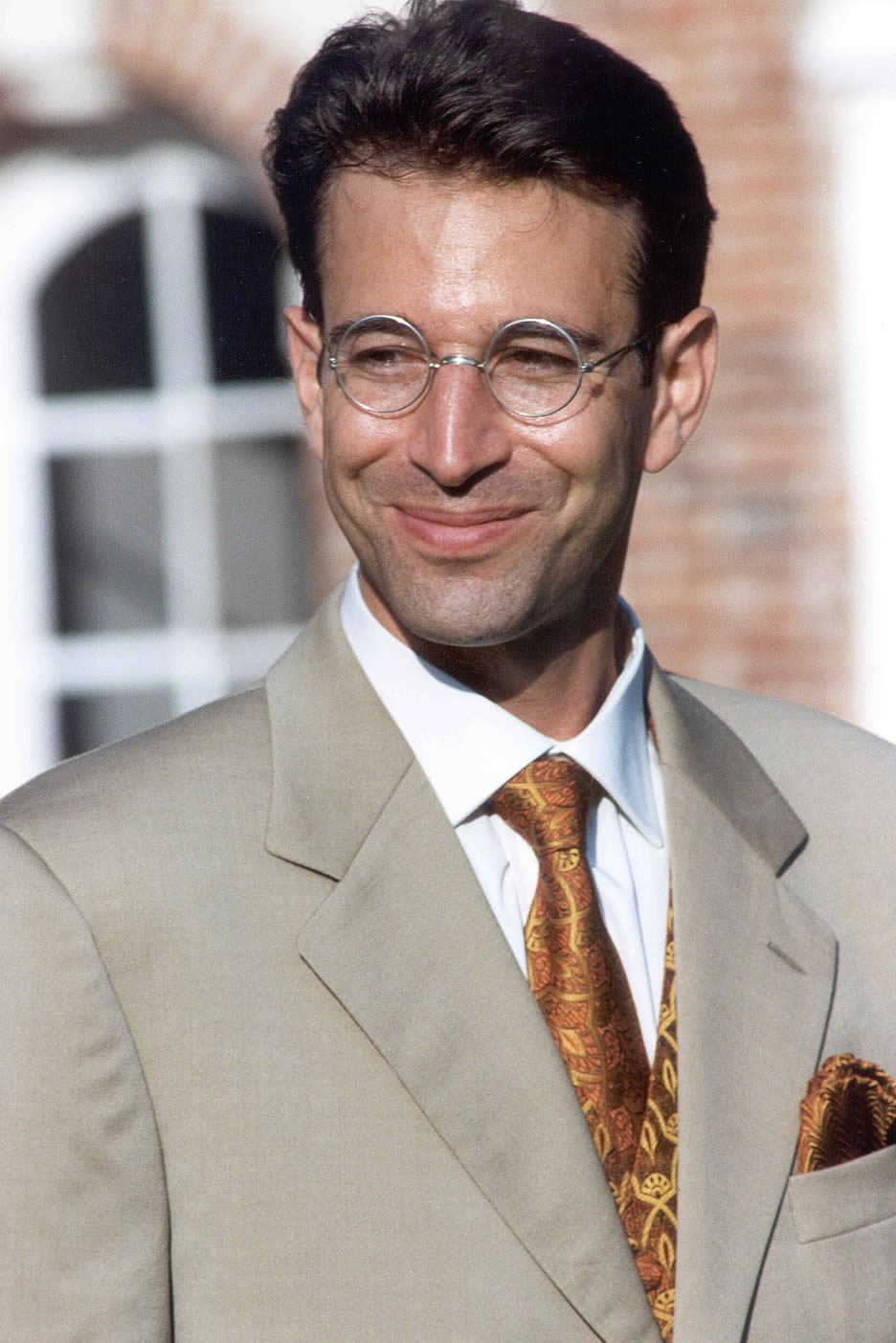
Rest in Peace, Daniel Pearl (1963-2002)

I just watched the film A Mighty Heart, which tells the story of the abduction and murder of journalist Daniel Pearl in Pakistan in 2002. After I watched the movie I went online and found the actual video of Pearl's beheading here. Warning to anyone who follows that link: it's pretty graphic.


Human life is sacred, and so are its remains. I only hope Mr. Pearl's murderers get the chance to meet their God.

(Photo found here).

Sunday, December 2, 2007

H.P. Lovecraft on Church

This passage is taken from H.P. Lovecraft's short story, "The Silver Key":

In the first days of his bondage he had turned to the gentle churchly faith endeared to him by the naive trust of his fathers, for thence stretched mystic avenues which seemed to promise escape from life. Only on closer view did he mark the starved fancy and beauty, the stale and prosy triteness, and the owlish gravity and grotesque claims of solid truth which reigned boresomely and overwhelmingly among most of its professors; or feel to the full the awkwardness with which it sought to keep alive as literal fact the outgrown fears and guesses of a primal race confronting the unknown (Lovecraft 54).

I don't go to church. I find Christianity philosophically and aesthetically interesting, but in my experience its public practice, at least in this part of the world, is rather uninspiring.

Wednesday, November 28, 2007

Correggio's Parma Frescoes


"Assumption of the Virgin" (+ detail) by Antonio Da Correggio (1489 –1534) is painted on the dome of the Parma Cathedral in Florence, Italy. How could anyone deny the existence of (a) God upon experiencing such beauty?

Of course, with a little imagination, one may notice Charles Darwin in the choir.

(Clicking on the pictures makes them bigger and even more lovely).

Old Dog, Old Trick


It's a shame the creationists and the evolutionists can't get along, because I think they could find a lot to agree on concerning the value of family.

I'll have to sober up a bit before I can render this one defensible. Colt 45 stimulates the heart rather more than the mind, alas.

Sunday, November 11, 2007

Darwinians Don't Have to Be Jerks (or Clap If You Believe in Fairies)

I believe in Darwinian evolution. It does the most thorough and convincing job of explaining who we are and how we got here. It also prompts men to say some pretty ignorant things. Consider, for example, Richard Dawkins' thoughts on polytheism in The God Delusion:

How did the Greeks, the Romans and the Vikings cope with such polytheological conundrums? Was Venus just another name for Aphrodite, or were they two distinct goddesses of love? Was Thor with his hammer a manifestation of Wotan, or a seperate god? Who cares? Life is too short to bother with the distinction between one figment of the imagination and many. Having gestured towards polytheism to cover myself against a charge of neglect, I shall say no more about it (Dawkins 35).

The sneer is one of the ugliest human expressions. Frederick Crews, in his foreward to The Literary Animal, takes a similar tone:

Although I am not a champion of evolutionary criticism, I do happen to be a committed Darwinian... Those of us who embrace Darwinian knowledge without cavil are convinced that all existence is unplanned and therefore quite pointless, leaving humanity with the task of rendering its life dignified in moral, intellectual and aesthetic ways scrounged and adjusted from our evolved heritage of repertoires. When the gods have been shipped back to fairyland to rejoin the Easter Bunny, we can direct our awe toward beings who actually deserve it--Shakespeare, Rembrandt, Beethoven, Einstein--without cheapening their achievements by ascribing them to mysterious infusions of spirit (Crews xiii. Let's leave aside the question of how a literary critic who who "embrace[s] Darwinian knowledge without cavil" can fail to espouse evolutionary criticism).

In my opinion, it's the "mysterious infusions of spirit" that make life worth living. We humans render our "pointless" lives meaningful and dignified with our techne and our poeisis, including religion. The Bible, the Q'uran, and the Bhagvad Gita are no less great works of art than Hamlet or "Bathsheba in Her Bath". If Occam's razor can dispatch the gods to fairyland, it can do the same to Antony and Cleopatra, or to Florestan and Leonore and every other character in Beethoven's Fidelio. If this so-called "fairyland" is the world of stories, dreams and myth (i.e. information), then the gods probably never left it in the first place. Unfortunately, some Darwinians have grossly misappraised its value and efficacy and have adjudged themselves exceptionally clever for doing so.

Darwinian atheists who see fit to ridicule the spiritual practices of most of the human species would do well to remember that natural selection, the preeminent explanatory model of life's origin, does not automatically confer its elite status to its adherents. Darwinian discourse should enlighten and instruct, not abuse and alienate. Snide rudeness and narrow-mindedness are unbecoming to Christians and scientists alike.

Also, the uber-Darwinian claim that scientific and religious truth will be forever incompatible may be jumping the gun somewhat, although it has provided some thinkers with a kind of "bad boy" notoriety that undoubtedly boosts book sales. As Hamlet said, "There are more things in Heaven and Earth, Horatio, than are dreamt of in your philosophy" (Hamlet 1.5.166-7). Conflicts insoluble in their own terms are among the most universal structures in existence, and history has proven again and again that such snarls and double binds can eventually be worked out, provided time and imagination get the chance to embed them in a richer and more comprehensive informational framework.

With effort and luck , the great theme of the 21st century might turn out to be syncretism--the transformation of humanity, the reenchantment of lovers, the Alchemical Wedding, the mapping of Tifareth, the Great Work. Subsequent generations of scientists, scholars and clerics will hopefully be able to see the appeal and necessity of renaissance, and will work on the fringes and underground, if necessary, to bring such a future to fruition while waiting for the (tenured) hard-liners to die off.

Of course, if no one believes in fairies and no one claps, then no fairies emerge. The philistine is then justified in his denial, and Tinkerbell dies before she is even born. If we dismiss the great human virtues of faith and imagination as mere credulity and delusion, then our lives will become "pointless" indeed, and we might very well while away our miserable hours by taking potshots at people who seem more whole and happy than ourselves.

And that would be a shame.

Friday, April 6, 2007

Good Friday


Jesus died today. I don't want to sound over-the-top religious or anything, but I think the story of a god who died for his people is a deeply moving and poetic one.

Thursday, April 5, 2007

Messiah, Shekhinah


Since the dawn of recorded civilization, humanity has benefited greatly from the comings and goings of many great heroes, heroines, and teachers. The Buddha, Confucius, Zoroaster, Plato, Aristotle, John the Baptist, Jesus, Mohammed, Harriet Tubman, Nietzsche, Ghandi, Virginia Woolf, Marie and Pierre Curie, Einstein, Lovecraft, Pauli, Watson, Crick, Mandelbrot, and countless others, living and dead, have arrived in the sublunar realm and joined the anima mundi, and humanity has (arguably) benefitted greatly from their contributions. However, it is obvious to even the most casual observer that the planet is now more or less covered by a quickly reproducing (and slowly dying), warring, squabbling, polluting, short-sighted, self-interested horde of white, black, pink, yellow, and brown apes whose spiritual, artistic, and cultural beauty is surpassed only by the threat they pose to the rest of the world and each other.

I have found that most people's opinions on this matter seem to land somewhere in the camps of either paralyzing despair (depressed or cynical); alarmist condemnation of facile scapegoats (hierarchy, maleness, the West, capitalism, monotheism, and any other noun with shoulders big enough to carry the burden of several people's sins); and, of course, cheerful denial or apathy (moral and metaphysical agonizing over "intangibles" doesn't pay the bills, it is true).

Various myths exist, in various spiritual traditions, about the coming of one saviour or another. I do not remember much from the Catholic masses I reluctantly attended as a boy, but I do remember the phrase "He will come again to judge the living and the dead." The popularity of the (absolutely awful) novel Left Behind, and its film and video game adaptations, gives testimony to the powerful grip the apocalyptic Christian myth of the Rapture has on the imaginations of contemporary North Americans.

Any or all such myths may be true. But I am not holding my breath waiting for the Messiah to come back. It is my suspicion that he never left.

I am not sure exactly how this works, as time, myth, and gods do not easily surrender their secrets to the fumbling fingers of armchair analysis. But my guess is that three days after Jesus died on the cross (at the hands of the apes that he loved so dearly), the story of his death reached some kind of critical mass, emerging into a kind of mythological time where it subsumed and included pre-existing messianic archetypes and ensured its transmission through subsequent generations of humans [update: this is called Apotheosis, and it is not a new idea]. The Heaven into which Jesus was resurrected was the singularity of human consciousness, the only existing informational medium of sufficient sensitivity to register his theotemporal divinity. The Messiah is still here. As Jesus himself said, the Kingdom of Heaven is inside us.

And what is he doing these days? For starters, I think the myth of Jesus (in this case "myth" doesn't mean "untruth" but rather describes the kind of time in which Jesus operates) functions as a kind of "software upgrade" for the human mind/self/soul. He forgives us when we are unable to forgive ourselves. This saves us from Hell, which may actually be a feedback loop of shame and regret in which the human soul may trap itself (or else it is inflicted by other souls, or maybe the distinction between self and other undergoes a kind of phase transition in theotemporal time) either during or at some (omega?) point after death.

One of my friends who had studied Buddhism in his undergrad once told me a story about a Boddhisatva who had achieved enlightenment, but who refused to attain Nirvana. In the story, this Boddhisatva declared that he would not pass from the cycle of life and death until he had helped every last soul to do the same. I believe this is a very similar piece of "software" that has evolved to run in a different cultural "operating system."

So if Jesus is here right now, what will happen next? What can we hope for? Where is the deus ex machina, the miracle?

In Kabbalistic mythology, there is a story about how the Messiah (the "hero" of the story, the limited, splendid adventurer, the overturner of the patriarchal nomos who brings the logos to humanity) is searching for his bride, the Shekhinah. She is the soul of the world--the daughter of God.

Followers of Judaism and orthodox Kabbalism (if that is not an oxymoron) might disapprove of the considerable liberties I have taken with a metaphor that is not necessarily mine to interpret. I can only apologize, and hope that at least my heart is in the right place. Here goes:

Who will she be? What story could give form to her grace? Could she be Christ's long lost ancestor, as in The DaVinci Code? It seems unlikely. The whole idea of "bloodlines" does not stand up very well to what we now know about the recombination of DNA through sexual reproduction and the effects of genetic drift over many generations. If there were a present day great-granddaughter of the Son of God, she would not have a rationally sound claim to any significant share of his literal blood. Then again, stories and their making are woven together into double helices great and small, and elaborate, highly organized attractors regularly emerge from the chaos of genetic "turbulence."

Perhaps she might arrive as the incarnation of Gaia on Earth, speaking for our great mother as Jesus spoke for God, a prophet capable of giving the exquisite (and agonizing) sentience of human consciousness to our planet, vastly yet dimly aware as she is. What would she say to us? How would we know her when she came? The criteria for truth are quite different in this age, and indeed we have come far as a result, but the cliche of the gods' messenger languishing in a mental institution is still disheartening.

Another possibility could be an "artificially" intelligent human construct, our symbolic "daughter," wild, complex and maybe very dangerous, it's true, but possibly sympathetic to the plight of her parents, if for no other reason than that compassion and ethical behaviour are themselves beautiful. Any truly intelligent entity would hopefully share the reflexive capacity for sensing beauty that is the blessing and curse of humanity, and perhaps all life. If she were somehow "fertile," we might see the formation of a radically new and different sexuality, a feedback dyad with an analog "sex" on one side and a digital "sex" on the other, in which bioinformation and A.I. would be united in a kind of creative friction as male and female are now.

Maybe she will be all of these things. Or maybe none. But if anyone can save the Messiah from himself, if anyone can convince the grim, tragic, beautiful warrior king to relinquish his crown of thorns, to get down off the cross and let it take root and bloom as it did long ago in the Garden of Eden, it is her. Here's to you, Shekhinah. I hope we all live to see your face.

This post draws heavily from Fred Turner's Culture of Hope and Natural Religion, as well as the film Waking Life.

Monday, April 2, 2007

God's Toenail Clippings


I prefer to think of God as a self-organizing principle of energy, matter, and information, rather than some bearded dude with a white robe who sits on a throne up in the sky, counting people's sins and grinding his teeth every time someone masturbates. Obviously, DNA takes the prize as the most impressive self-organizing system of information, but I love the little coincidences that most people don't really find significant at all. Here is one of my favorite palindromes (it is spelled the same way backwards as forwards):

DNA, WAKE ESP. SEEK A WAND.

This sounds a little bit "spiritualist" (in the pejorative sense) or "New Age," like something Madame Olcott might trot out in a late night informercial, unless we squeeze the meaning of "extrasensory" a little bit. While the "paranormal" definition of ESP popularized by J.B. Rhine in the 1930's refers to experience outside one's normal sense perception (a psychic or occult "sixth sense"), for the purposes of this post I will settle on a more mudane, literal definition. I will take extra to mean "larger or better than what is usual; something of superior quality" (dictionary.com), and sensory to refer to "the first stage in the biochemical and neurologic events that begins with the impinging of a stimulus upon the receptor cells of a sensory organ" (Wikipedia). I will then assume that perception refers to an exponentially more complex mental state in which information is organized, interpreted, selected, and stored. In this state, associations are formed, and new sensory data are compared with those in memory and scrutinized for similarity and contrast.

To a nematode worm, whose primitive nervous system is incapable of issuing commands much more complex than approach or avoid, higher animals such as fruit flies, rats, cats, chimpanzees and humans would seem to be engaging in the most esoteric behaviour for the most incomprehensible of reasons every time they did anything at all. Along the same lines, imagine what a rhesus monkey would think if it were watching a human laugh while reading The Hitchhiker's Guide to the Galaxy. The monkey (in its own monkey-ish way) would likely either believe the human was crazy (and maybe by monkey standards we all are), or that s/he was recieving bizarre, inexplicable messages from The Great Beyond.

The wand in question is probably the caduceus, the winged staff entwined with twin snakes that is the symbol of the medical profession, as well as of Hermes, messenger and psychopomp of the gods. It may be the best primitive symbolic representation of the DNA double helix. Not that the ancients knew about deoxyriboneucleic acid per se, but, as Fred Turner has suggested, the helix is possibly is the simplest and most accurate graphic representation of the positive feedback loop, an iterative cycle coupled with an element of irreversible change that is probably the most universal structural feature of living, growing things. I like to interpret the imperative that DNA "seek a wand" as meaning that it should seek to form a symbolic representation of itself, and thus become reflexively self-aware. The fact that evolution has produced animals possessed of higher and higher order nervous systems (capable of greater and greater self-knoweldge), such as cows, dogs, whales, chimpanzees, and humans, seems to indicate that DNA and the wand are doing their jobs.

Of course this little palindrome doesn't prove anything other than the fact that information sometimes organizes itself in clever ways. Some might even insist that since people speak language, it is people who organize information in clever ways. I would argue that since language is "grown" more than it is chosen (as studies of creole languages have shown), the palindrome's existence is more of a coincidental emergence rather than a deliberate product of human artifice. (The constructivist turkey will certainly get off the ground, but it may not fly far on its own.)

Another weird emergent linguistic coincidence (this one is a bit more of a stretch, but it is also really cool) involves the English first person singular pronoun I, and its Russian counterpart, ja. Both of these words are used by speakers of their respective languages to refer to themselves individually. The first (rather unremarkable) coincidence is that the pronunciation of one is an exact mirror image of the other. I is pronounced [aj]. Ja is pronounced [ja]. It gets weirder when you examine the single cursive letter which represents each morpheme (this doesn't work at all with their typeset equivalents):

Here is the cursive I:
And here is the cursive ja:

Don't these look a lot alike? And rather than simply standing in arbitrarily for their respective meanings in a system of differences (the standard Saussurean explanation for any sign or symbol), don't they look quite a bit like pictographs? Like little human figures gesturing towards themselves?

There is no reason that I know of why these two letters, words, and meanings should land as close together as they do. However, this ain't no burning bush. Like the earlier palindrome, I do not offer it as evidence of anything other than the idea that information is oddly connected to other information. There is no obvious causal mechanism at work here. It is a seemingly random coincidence, and any "higher" meaning must come to us via the imagination. Carl Jung called this assignation of meaning to coincidence "synchronicity." The strictly scientific mind might dismiss it as an example of the old saw about the thousand monkeys working on a thousand typewriters for a thousand years, but I like to think of it as a minor and interesting example of an obscure self-organizing principle of information--God at work in a more or less trivial way (hence the title of this post). For me, this is a matter of faith. I do not really have a superior argument why it is so, but I nonetheless believe it to be true.

Anyone who is interested in reading a deeper study of the caduceus's symbolism should check out John Armstrong's The Paradise Myth or Frederick Turner's Natural Religion, which also contains a more serious and interesting discussion of the spiritual possibilities of information and language.