Frederick Sandys, 1829-1904
(Image from wikipedia.org.)


 I suspect the taste for self-consciously ironic cliché and the general paucity of intellectual and moral brilliance in the North American media these days has something to do with 20+ years of increasingly bad “language arts” and English classes, among other things. While English inevitably has to be taught as a basic communicative tool at the lower end of the student ability spectrum, the increasing focus at the higher end on “media literacy” and “cultural literacy," i.e. thematically organized “critical thinking” about commercial and political rhetoric, seems to have occurred mostly at the expense of actual literacy, i.e. learning to read and write well by studying the work of a variety of excellent and challenging writers while reading and writing as much as possible. Speaking from my own experience and biases, I'd like to suggest that the latter inculcates a healthy and respectful skepticism; the former, cynicism and paranoia. One helps create an individual who is judicious, imaginative and capable of appreciation as well as critique; the other implicitly associates sincerity with gullibility, and fosters a reflexive (defensive?) attitude of boredom and incredulousness--of having "seen it all" already. One teaches the value of informed opinion and reasoned argument, while the other is incapable of distinguishing between the two, and tends to breed adults who have no time for either insofar as these concern anyone unlike themselves.
 ME: Well, if my new sneakers are a whole size too big, I'll be tripping over those big gaps in the Texan sidewalk.
 The Onion's "Our Dumb World" is an online map of the world on which users can scroll around and read satirical factoids located at various points on the map. When a country is "featured" for the week (or month, or whatever) the blurbs proliferate within its borders. The problem with "Our Dumb World" is similar to the problems with The Simpsons' "Africa" episode or Hostel's handling of its Slovakian setting: it tries to pass off the writers' ignorance of the subject matter as a satirical critique of America's ignorance of the rest of the world. This week's featured country is Romania, and the various jokes include a spooky castle, a spooky path, a picture of Nicolae Ceauşescu dressed as Count Chocula on a box of cereal, a used coffin dealership (bored with the vampire schtick yet?), a gymnast in a Bride of Frankenstein fright wig, and some 11 other jokes about mad scientists, werewolves, vampire bats and reanimated corpses. What is conspicuously absent is evidence of any research whatsoever concerning Romania past or present, despite an abundance of such information on websites an 8-year-old could use. The Ceauşescus, for example, were killed in their dotage by assault rifles on Christmas Day. Or a one-step Google search for "Romanian jokes" yields this communist-era gem:
 To the extent that we're responsible, life is tragicomic and we are free. To the extent that we're not responsible, life is a melodrama or horror story and we are not free. If we want to be able to laugh at ourselves and forgive others, it seems to me that we should cultivate self-discipline and generosity, not excuses.
 Critics of postmodernism and poststructuralism, such as Alan Sokal, Paul R. Gross and Norman Levitt, Frederick Turner, Joseph Carroll, etc. have been criticized themselves for making straw men of their opponents' arguments. I think this criticism is valid to some extent: Turner's pointed critique of the postmodern avant garde in Culture of Hope and Carroll's treatment of "textualism and indeterminacy" in "Theory, Anti-Theory and Empirical Criticism" do tend to reduce much of the past 40 years of literary theory to grouchy caricatures. However, after reading some of the Marxist New Historicists on Shakespeare, such as Stephen Greenblatt, Jean Howard, Stephen Orgel, and Richard Levin, I couldn't help but notice that they also rely heavily on constructs such as the bourgeois straw man, the Western metaphysical straw man, the positivist straw man, the formalist straw man, the capitalist straw man, etc. Orgel and Greenblatt, in particular, see fit to mock and sneer at these as well.
 Just needed a link to your picture, you old goat. Having met you even once, how could anyone ever forget you? Moc mi chybí.
 Adventures of Huckleberry Finn uses the word "nigger" over 200 times. The Merchant of Venice depicts the humiliation and ruin of a Jewish villain at the hands of a Christian majority; Othello, a negro who strangles his perfectly innocent wife. The famous first line of Pride and Prejudice can be read as a blatant formula for prostitution, if one so chooses. The women of Sir Gawain and the Green Knight inspire and manipulate their men, but don't engage in any decapitating contests themselves.
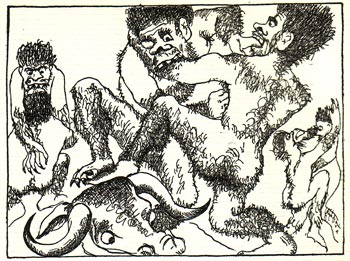
  So I was reading this news story about a fat man who killed his wife on Yahoo news today, and I impulsively clicked on the "comments" section. What I found there was worthy of part 4 of Gulliver's Travels:
When I want quality conversation, I go to the comments section of Yahoo news. Where else could I find so many people willing to share their informed, measured and enlightening opinions? Keep up the great work, folks!

 I just finished reading Adbusters' July 2008 article, "Hipster: The Dead End of Western Civilization", and I think Douglas Haddow got it mostly wrong--the counterculture hasn't lost its values at all. The beatniks, the hippies, the punks, the hip-hoppers, the ravers, the anti-consumer movement, etc. all concern(ed) themselves with an elaborate system of in-group fashion semiotics and justifications for having a good time (i.e. looking good and having fun) couched in contemporary political terms. Today's kids may just want to party without feeling as obliged to justify it as "subversive" or "revolutionary," but if they still want to be different from (i.e. cooler than) the kids across the street, then the aforementioned "countercultural" values are intact, minus some of the political pretension. I say good for them. Posers will always be posers, but posers who think they're activists are worse.
 Kilgore Trout once wrote a short story which was a dialogue between two pieces of yeast. They were discussing the possible purposes of life as they ate sugar and suffocated in their own excrement. Because of their limited intelligence, they never came close to guessing that they were making champagne.
 Most people (e.g. me) whose parents weren't active in the KKK grew up thinking, rather naively, that racism is the belief that one's own race is superior and other races are inferior. By contemporary standards, this is not exactly true--the inner logic of political correctness is more convoluted than that. For example, a positive opinion of another group expressed for the wrong reasons is still racist (e.g. "orientalism," "white guilt"), while a sweepingly negative statement denigrating all members of a particular group is not necessarily racist: if the target group has more members and/or a higher average socioeconomic status than that of the person uttering the statement, it's "reverse racist." It can also be tricky to tell "ironic" racism from the real thing, especially in our present cultural climate, wherein edginess is valued over intelligence, and low quality satire often reinforces the very ideas it's intended to critique.

_-_Time_Clipping_Cupid%27s_Wings_(1694).jpg)